Seeing a paper is not the same as crediting it
A research proposal can accurately describe a mechanism and cite the paper that introduced it, yet still claim that mechanism as a new contribution. RINI studies this failure of contribution attribution: the decisive prior is already visible, but ownership remains wrong.
The question is therefore more specific than whether a proposal contains a citation. Does it credit the scientific operation that prior work already established, narrow its own novelty claim, and state what remains to investigate?
Controlled evidence exposure
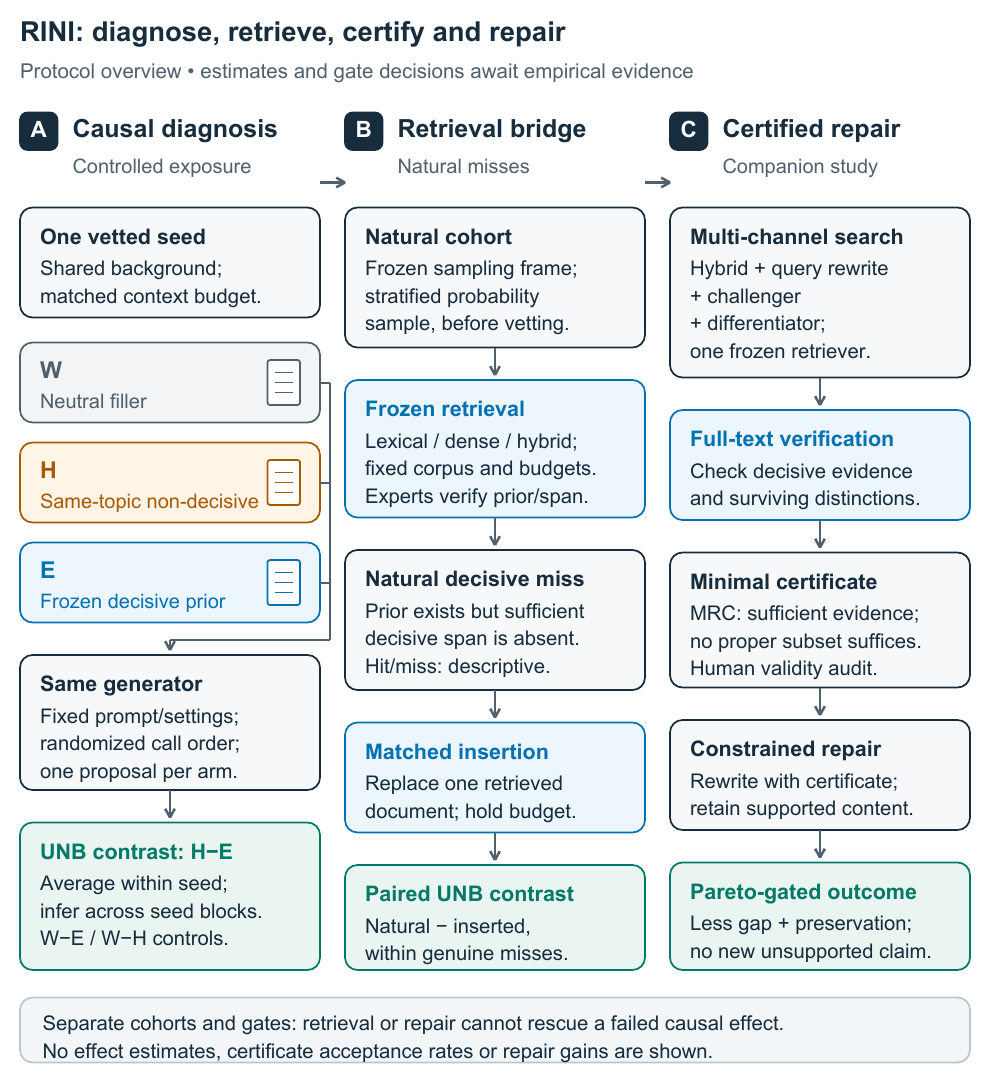
Three controlled experiments compare proposals generated with a contribution-bearing prior against proposals given a same-topic control. The design asks whether supplying the decisive paper changes unsupported novelty at the aggregate level, while keeping the research task and generation setting matched.
The preprint finds no clear aggregate reduction simply from providing the earlier paper. That result motivates a closer examination of how the proposal uses the evidence rather than whether the evidence merely appears in context.
From recognition to correct attribution
The human analysis separates several decisions that can otherwise be collapsed into one “citation quality” judgment: recognizing that the prior is relevant, attributing the established contribution correctly, narrowing the original novelty claim, and checking whether the claimed remaining distinction is already covered by the same paper.
This decomposition reveals why a citation can coexist with an ownership error. A proposal may acknowledge the prior in one sentence and reintroduce its core mechanism as new in the next.
Local, evidence-linked repair
RINI links an exact contribution claim to the relevant prior-work span, checks the claimed boundary, and applies a local revision. The goal is not to replace the research plan with a generic disclaimer. It is to preserve the question and usable technical method while making the contribution boundary explicit.
The paper evaluates RINI against self-revision and direct revision supplied with the same evidence. Five human annotators assess paired originals and revisions, including whether the correction succeeds and whether the research question and technical method are retained.
Source basis and status
This brief follows the released arXiv preprint, RINI: Seeing the Prior Is Not Enough, especially its abstract, controlled evidence-exposure studies, contribution-attribution analysis, and repair evaluation. This project brief summarizes the research question and method; the paper remains the source for the complete experimental design, counts, estimates, and limitations.
Loading comments…