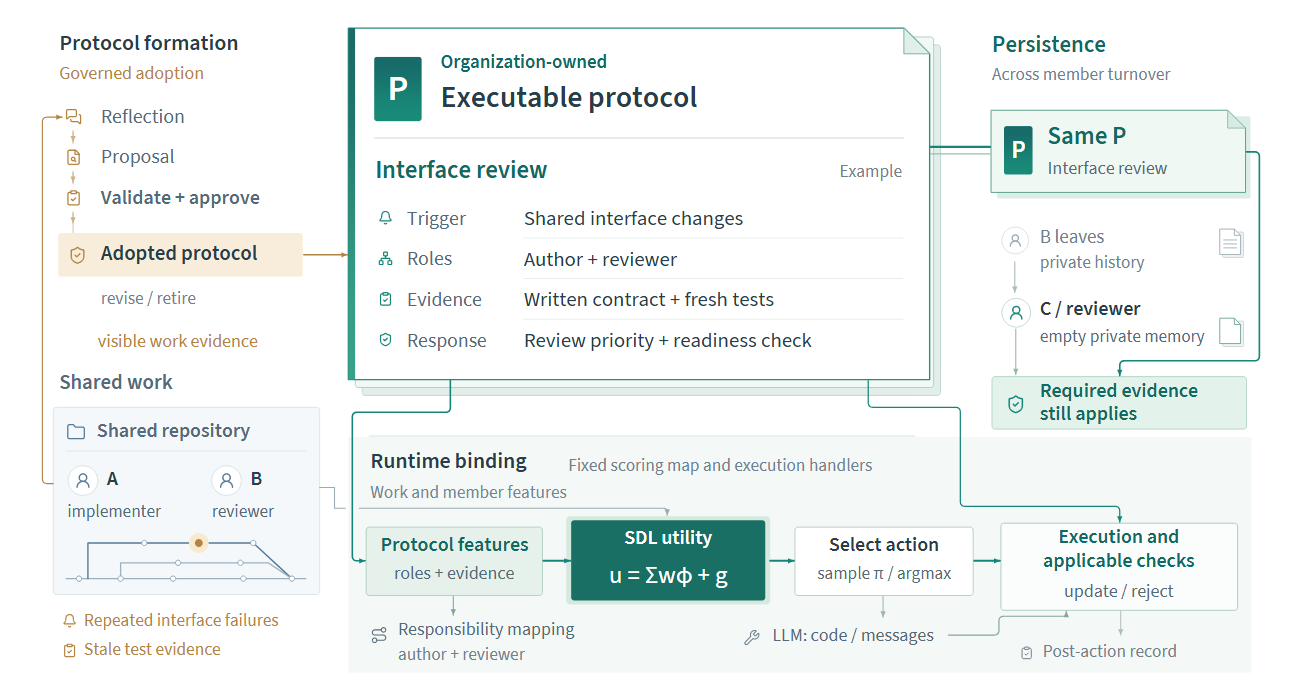
What belongs to the organization?
RELIC studies whether agents can turn recurring coordination problems into capabilities that survive the members who first developed them. Its central object is member-independent protocol state: reusable rules specifying when they apply, which roles participate, what evidence is required, and how they affect subsequent work.
The manuscript distinguishes three things that are often grouped together as memory: a member’s private history, shared work artifacts such as code and documents, and organization-owned protocols. Keeping a repository alive is not, by itself, the same as retaining a governed way of working.
From work evidence to executable protocols
Recurring friction in shared work prompts reflection and an evidence-grounded proposal. Validation and governance determine whether that proposal becomes an adopted protocol. The protocol then connects to supported runtime hooks, so its requirements can influence action selection and applicable checks. Later evidence can motivate revision or retirement.
For example, repeated interface failures can motivate a shared interface-review protocol: identify the author and reviewer, require a written contract and fresh tests, and connect that evidence to readiness checks. The rule belongs to the organization, so a replacement reviewer can inherit its responsibilities without inheriting the previous reviewer’s private memory.
RELIC keeps the underlying action scorer, action registry, and execution handlers fixed. The learned object is the governed protocol and its bounded runtime binding—not unrestricted self-modification or a universal veto over every action.
Formation, effectiveness, and transferability
The manuscript separates whether a protocol is formed and reused from whether it improves work. Adoption counts alone do not establish organizational capability. Its evaluation design also compares readable protocol text with executable bindings and examines transfer to fresh products and fresh members.
In the transfer setup, the organization carries a frozen protocol package and role mappings, not the source product’s code or member-private histories. This tests whether a reusable way of working travels beyond its original context.
CooperBench and ProgramBench are external evaluation settings for the research program, not RELIC subprojects. This page does not publish unreleased quantitative comparisons; those require their task, model, condition, and evaluation evidence alongside the result.
Human–Agent Organization
RELIC’s exploratory HCI extension asks how a person can understand and participate in an organization that is already operating autonomously. A human work unit includes the human, a liaison, and agents delegated to carry out work.
The liaison coordinates that work and communicates relevant organizational state. Deliverables still enter the common review, testing, and protocol checks. Human participation does not turn the liaison into the manager of the entire organization.
Explore the Human–Agent Organization →
Long-horizon research foundations
The project’s earlier testbed work studies agent organizations with persistent roles, shared repositories, documents, and workspaces. It includes professional-profile graphs and OrgEnv, a product-development environment for investigating collective work over time.
My contributions span problem formulation, profile-graph construction, experimental design, and evaluation of product-development activity. These foundations belong to the same RELIC research direction, alongside the current focus on executable protocols and organizational capability.
Source basis
This brief follows the current working manuscript, RELIC: From Multi-Agent Collaboration to Organizational Capability: its introduction, protocol lifecycle and runtime-binding method, evaluation design, and exploratory HCI appendix. The earlier testbed work above is retained as project history, not substituted for the manuscript’s current contribution. A public manuscript link will be added when available.
Loading comments…