Turning a problem into a model
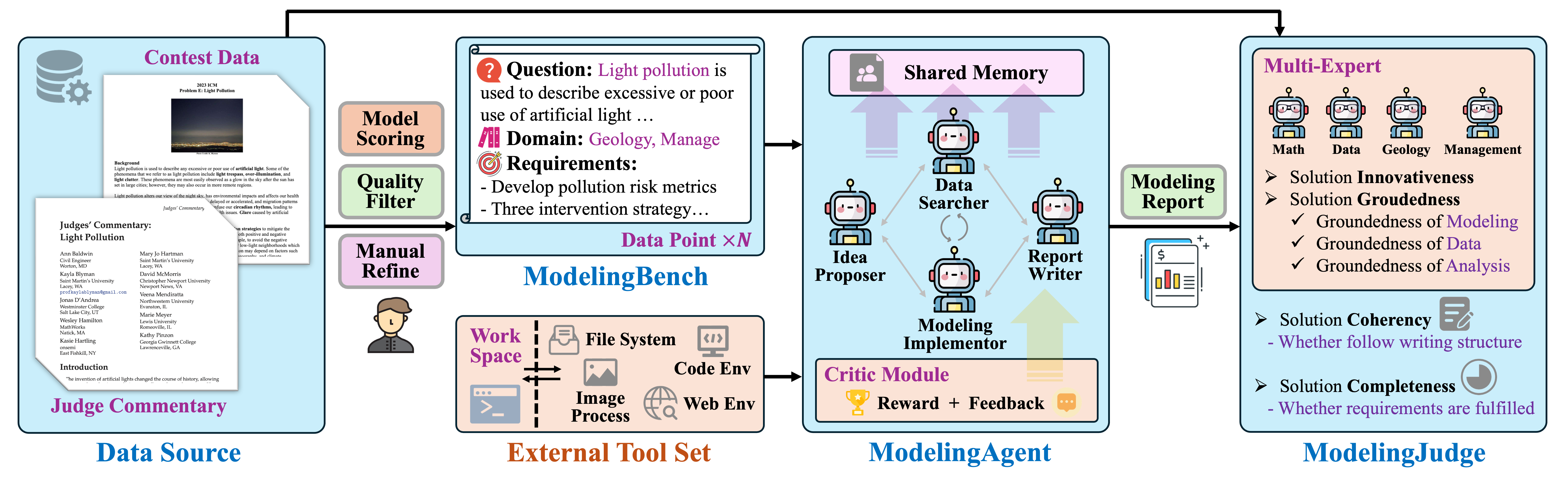
ModelingAgent addresses open-ended problems that require a mathematical formulation, computational tools, and a defensible report. Unlike a single-answer exercise, a practical modeling task can admit several valid solutions with different assumptions and trade-offs.
A connected research framework
ModelingBench supplies competition-derived problems across domains such as transport, ecosystems, and operations. ModelingAgent connects four roles—Idea Proposer, Data Searcher, Modeling Implementor, and Report Writer—through shared memory. A Critic Module supports iterative refinement, while tools provide data access and code execution.
ModelingJudge assesses the resulting reports through multiple expert perspectives. Its evaluation considers completeness, coherence, grounding, and innovation rather than checking only a final number.
Place in the research agenda
This work appears at the Agent scale because it asks how model capability becomes effective task execution. Its actual architecture is multi-agent. The research map organizes questions; the paper describes the system in full.
Paper and contribution
Hongyi Du is a co-author. This brief follows ModelingAgent: Bridging LLMs and Mathematical Modeling for Real-World Challenges, including the framework and evaluation design. The work appeared in Findings of EMNLP 2025. Implementation details are available in the repository.
Loading comments…